English| EUR
Suggested for you
More currencies
Choose a language
Choosing between a catamaran and a monohull determines your entire experience on French Riviera waters. The decision hinges on priorities: stability and space versus traditional sailing dynamics and docking flexibility. Understanding how each hull design performs in Mediterranean conditions clarifies which vessel fits your coastal journey.
Quick answer
Catamarans offer superior stability and deck space, making them ideal for families, groups, or those prone to seasickness along the French Riviera's calmer summer waters. Monohulls deliver authentic sailing feel, better upwind performance, and easier marina access in crowded ports like Nice and Antibes. The best choice depends on passenger count, sailing experience, and whether you prioritize comfort or traditional handling. Both vessel types operate year-round through private charters and tour operators, with entrance fees not applicable to vessel selection.
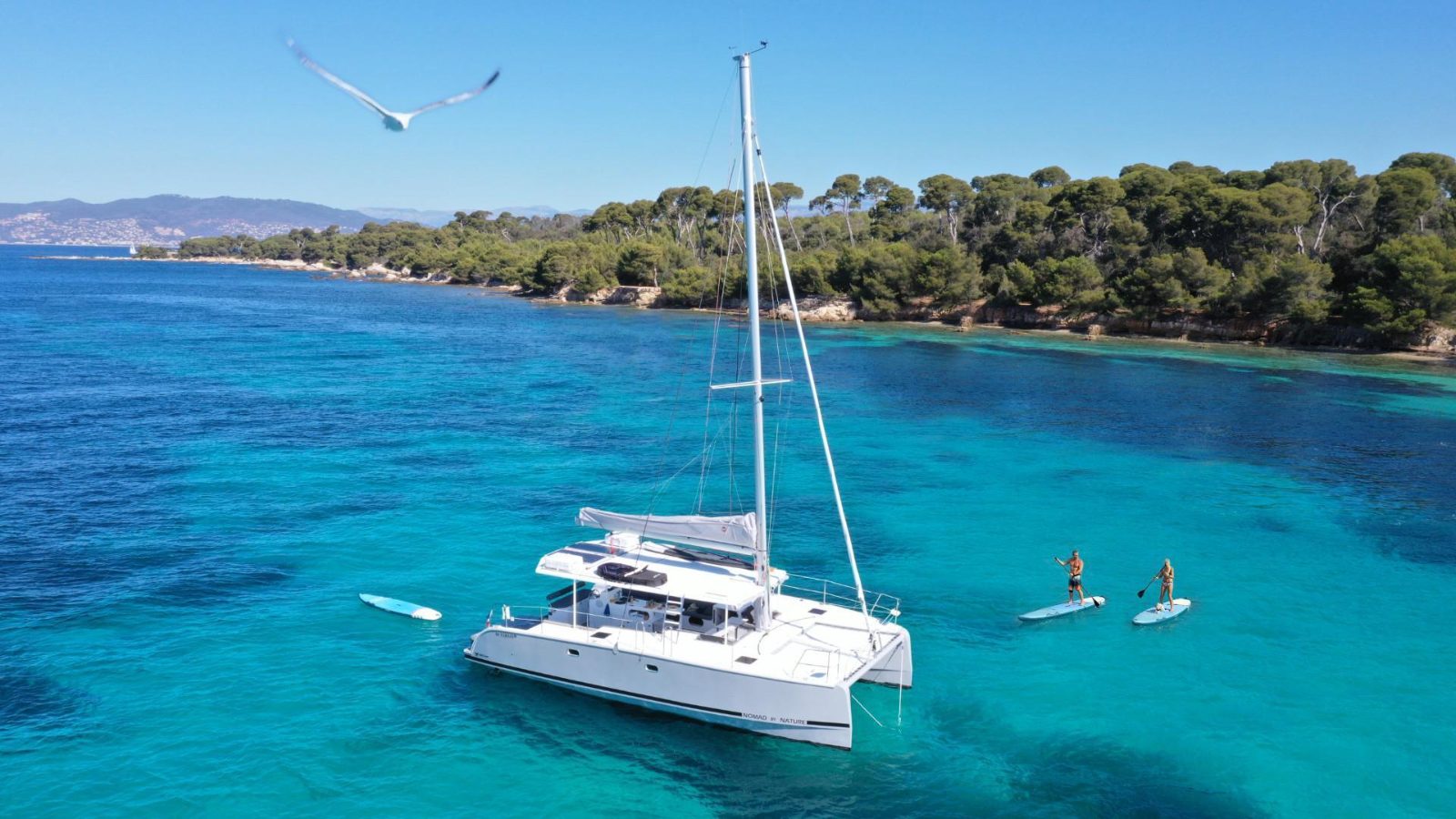
The French Riviera's yacht charter industry records over 40,000 private bookings annually, yet most first-time sailors misjudge how hull design affects their day on the water. A catamaran's twin-hull configuration creates a wide, stable platform that remains nearly level even when winds pick up past Cap Ferrat. Families with young children and passengers sensitive to motion find the reduced heel angle transforms their comfort level. The trampoline netting stretched between hulls becomes de facto seating, and the salon typically sits at deck level rather than below, maintaining visual connection with the coastline. Monohulls slice through waves rather than riding over them, offering responsive feedback to every sail adjustment and wind shift. Sailors who learned on keelboats appreciate the tactile connection—the boat heels, you adjust, the vessel responds. In the French Riviera's frequent summer Mistral conditions, a monohull's deeper keel provides better upwind tracking than a catamaran's shallower draft. The narrower beam also matters practically: many historic ports along the Côte d'Azur allocate slips by vessel width, and a 12-meter monohull secures berths a similarly-sized catamaran cannot fit. Space allocation differs fundamentally between designs. Catamarans separate cabins into port and starboard hulls, granting privacy impossible on a monohull of equivalent length. Cockpit and foredeck areas expand dramatically when you spread load-bearing structure across two hulls instead of one central axis. Groups of six or more find catamarans eliminate the crowding that defines monohull cruising. The tradeoff appears in marinas: monthly mooring costs for a 12-meter catamaran often double those of a comparable monohull due to beam width. Speed profiles favor different conditions. Catamarans excel in downwind and beam-reach sailing, their light displacement and wide stance generating higher averages when winds cooperate. Monohulls regain advantage when tacking upwind or navigating confused seas, where a single deep keel cuts through chop a catamaran must climb over. The calmer morning seas between 09:00 and 11:00 smooth performance gaps, making this the optimal arrival window for stable conditions regardless of hull type you choose.
“A catamaran's twin-hull configuration remains nearly level even when winds pick up past Cap Ferrat, transforming comfort for passengers sensitive to motion.”
Selecting between a catamaran and a monohull for your French Riviera charter depends on whether you prioritize passenger comfort and deck space or the traditional sailing experience. Both vessel types offer unique advantages for navigating the Mediterranean coastline.
| Catamaran Multi-hull stability and space Recommended | Monohull Traditional sailing feel | |
|---|---|---|
| Stability at anchor | Minimal roll in calm seas | Noticeable heel and roll |
| On-deck living space | Wide, flat saloon and deck | Compact, vertical layout |
| Access to shallow coves | Limited due to wider beam | High due to narrow beam |
| Heeling/Sailing feel | Upright sailing experience | Dynamic leaning under wind |
| Docking complexity | Requires wider berth space | Standard slip compatibility |
Verdict: Choose a catamaran for group comfort and stability, or a monohull if you prefer a classic, responsive sailing experience.
The best arrival window is 09:00–11:00, as calmer morning seas provide the most stable conditions for both catamarans and monohulls. Navigating the French Riviera early helps avoid the typical afternoon swell that develops as winds increase.
Mild, 20°C–25°C; ideal sea states
Early season offers stable morning conditions and comfortable temperatures for all vessels.
Warm, 25°C–30°C; thermal afternoon winds
High demand requires early arrival to secure preferred sailing times.
Pleasant, 18°C–23°C; lower wind probability
Water remains warm and conditions are often calm during the morning hours.
—
The 09:00–11:00 window offers the quietest experience on the water.
Verdict: For the most stable sea conditions, aim for an arrival between 09:00–11:00 during the months of May, June, or September.
Access to vessels across the French Riviera coastline is determined by the specific departure port assigned by your charter or tour operator. Regardless of whether you select a catamaran or monohull, most operators facilitate boarding at major regional ports easily accessible by public transport or road.
TER Sud train to Nice-Ville or Cannes station
Lignes d'Azur network to port-adjacent stops
A8 motorway towards Nice or Cannes
Follow harbor signage to the designated pier
Plan your travel to reach the French Riviera Coastline, France, during the best arrival window of 09:00–11:00. Arriving during this period ensures the calmest sea conditions for your departure.
Selecting the right vessel requires balancing the social dynamics of your group with the physical characteristics of the French Riviera coastline.
A monohull is often restricted to smaller groups due to limited deck space, whereas a catamaran provides an expansive layout ideal for larger parties. Choose the catamaran if maintaining personal space while socializing is a priority for your guests.
If anyone in your party is prone to seasickness, the catamaran is the logical choice due to its dual-hull stability that minimizes rocking. Monohulls will heel under sail, which can be unsettling for those not accustomed to nautical conditions.
Monohulls often have a deeper draft, allowing them to anchor closer to shore in specific protected bays along the Esterel massif. Catamarans offer greater maneuverability in shallow waters, provided the vessel beam does not exceed local mooring constraints.
Be aware that catamaran beam dimensions often result in higher berth fees in popular ports like Antibes or Saint-Tropez. Check with your charter operator regarding whether your chosen vessel fits standard slips to avoid unexpected logistical delays.
Select a monohull if your interest lies in the traditional sailing experience and tactile feedback from the helm. Choose a catamaran if your objective is a platform for swimming and lounging, as the deck remains level even when underway.
Everything you need to know about which is better catamaran or monohull
When evaluating which is better catamaran or monohull, prioritize your group size and comfort preferences. While catamarans offer expansive deck space and stability, monohulls provide a traditional, sporty sailing experience. Consider the specific coastal itinerary before making your final selection.
For day trips along the French Riviera, catamarans are often favored for their shallow draft, which allows access to secluded coves near the shoreline. Deciding which is better catamaran or monohull depends on whether you seek high-speed performance or leisurely lounging areas. Both vessel categories are readily available for booking.
Stability is a key factor when considering which is better catamaran or monohull for your excursion. Catamarans feature twin hulls that significantly reduce rolling motions in typical Mediterranean conditions. This inherent stability often leads guests to prefer multihull vessels for a smoother experience on the water.
For the best experience, aim to arrive between 09:00 and 11:00. Calmer morning seas provide the most stable conditions for both vessel types, regardless of your choice. Starting your journey early helps you avoid the busiest periods on the coastline.
When families ask which is better catamaran or monohull, the answer frequently leans toward catamarans. Their flat deck configuration and generous shaded seating areas provide a safer environment for children to move around freely. Additionally, these vessels typically feature easy boarding ladders for swimming stops.
Monohulls offer a classic sailing aesthetic and perform well when heeling under wind pressure, whereas catamarans remain level. The primary distinction involves deck layout, interior cabin volume, and the overall sensation of movement while underway. Understanding these traits clarifies the choice between the two.
There is no standard entrance fee for boat charters as costs depend on whether you select a private charter or a group tour operator. Access to the coastline is free, but vessel usage requires a booking based on your specific trip requirements.